
Why Can't I Fit Anything in My Closet?
You're struggling to fit anything in your closet because you're likely making some common organization mistakes. You might be skipping color coordination, neglecting seasonal rotation, and not utilizing storage bins and baskets. Your closet's problem areas, like scattered shoes and crammed clothes, are taking up valuable space. To fit more in, start by purging your wardrobe, maximizing vertical storage, and creating a strategic layout. You'll be surprised at how much more you can store when you use the right containers and make the most of hidden spaces. Now, take a closer look at your closet's specific challenges and get ready to uncover the solutions that will transform your space.
Key Takeaways
• Common closet organization mistakes, such as neglecting seasonal rotation and avoiding storage bins, can lead to clutter and disorganization.
• Identifying problem areas, like scattered shoes and crammed clothes, helps to prioritize and address specific organizational needs.
• Maximizing vertical storage space with shelves, bins, and baskets can increase storage capacity and reduce clutter.
• Purging and editing your wardrobe by sorting items into keep, donate, and discard piles can help to declutter and free up space.
• Creating a tailored closet layout strategy, including grouping similar items and utilizing color coding, can optimize storage and make the most of available space.
Common Closet Organization Mistakes
You're likely making at least one of these five common closet organization mistakes that are preventing you from fitting anything in your closet.
First, you might be skipping color coordination. Think about it - when your clothes are arranged by hue, your closet looks more organized, and it's easier to find what you need.
Next, you're probably guilty of not doing seasonal rotation. Why store your winter parka next to your summer sundress? It's a waste of space! Take the time to swap out seasonal items to free up room for the clothes you actually wear.
Another mistake isn't using storage bins and baskets to keep accessories and shoes in check. And let's be real, who hasn't fallen victim to the 'I might wear it someday' syndrome? Be honest with yourself - if you haven't worn it in a year, it's time to let it go.
Finally, you might be neglecting to utilize the back of your closet door or the ceiling for extra storage.
Identifying Your Closet's Problem Areas
Now that you've pinpointed the common closet organization mistakes, it's time to take a closer look at your closet's specific trouble spots. Think of it as a closet intervention – you're about to get real with your storage space. Take everything out (yes, everything) and sort items into three categories: keep, donate/sell, and toss. This will help you identify areas where closet clutter is piling up and causing clothing overflow.
| Area | Symptoms | Solutions |
|---|---|---|
| Floor | Shoes scattered everywhere, no clear path | Designate a shoe station, use stackable shelves |
| Shelves | Folded clothes are a mess, hard to find what you need | Implement a color-coded system, use dividers |
| Rod | Clothes are crammed, hard to find what you want | Use slim hangers, group similar items together |
Maximizing Vertical Storage Space
By making the most of your closet's vertical space, you can greatly increase storage capacity and reduce clutter. Think of it as building a skyscraper in your closet – the higher you go, the more stuff you can fit!
Start by maximizing your closet shelf space. Install shelves that are sturdy enough to handle the weight of your belongings, and consider stacking storage bins or baskets to keep items like linens, out-of-season clothes, or accessories organized and out of the way.
Next, take advantage of your hanging rod's vertical potential. Add extensions to create multiple levels of hanging space, allowing you to double or even triple your storage capacity. This is especially useful for items like dresses, coats, or suits that take up a lot of space when laid flat.
By utilizing these vertical storage solutions, you'll be amazed at how much more you can fit in your closet – and how much easier it's to find what you need in the morning!
Purging and Editing Your Wardrobe
Take a hard look at your wardrobe and be honest with yourself: are there items in there that you haven't worn in months, or that no longer fit or flatter you? It's time to purge and edit! Start by taking everything out of your closet and sorting items into three piles: keep, donate, and discard. Be ruthless – if you haven't worn it in a year, it's probably safe to let it go.
As you sort, consider the capsule wardrobe approach: a small collection of versatile, high-quality pieces that can be mixed and matched to create multiple outfits.
You can also host clothing swaps with friends or join online communities to exchange gently used items and refresh your wardrobe without breaking the bank.
Minimalism trends may have you thinking you need to get rid of everything, but that's not necessarily the goal. The idea is to curate a wardrobe that makes you feel confident and comfortable, with pieces that bring you joy.
Creating a Closet Layout Strategy
You'll need to measure your closet space to determine the most functional layout, considering the dimensions of your clothing items, storage containers, and shelves. This will help you create a space that's tailored to your needs and makes the most of the available space.
Here are some strategies to keep in mind:
-
Group similar items together: Organize your clothes by type, such as tops, bottoms, dresses, and outerwear. This will make it easier to find what you need and prevent clutter from building up.
-
Use vertical space: Maximize your closet's vertical space by installing shelves or storage units that go up to the ceiling. This will help keep your floor clear and make the most of your closet's square footage.
-
Implement color coding: Organize your clothes by color to create a visually pleasing and easy-to-navigate space. This can also help you identify gaps in your wardrobe and plan your outfits more effectively.
- Don't forget about shoe racks: Dedicate a specific area for your shoes to keep them organized and prevent them from getting scattered throughout the closet.
Selecting the Right Storage Containers
When it comes to selecting the right storage containers for your closet, you'll want to choose ones that fit your specific needs. You'll need to take into account the size of the items you want to store and pick containers that are the right fit - not too big, not too small.
Container Size Matters
Selecting storage containers that are the right size for your closet's contents is crucial, as it directly impacts how efficiently you can store and retrieve your belongings. You don't want to be stuck with containers that are too small or too large for your stuff. Imagine trying to cram a giant sweater into a tiny bin – it's a recipe for disaster!
To get it right, consider the following:
-
Measure your closet dimensions: Take note of the width, height, and depth of your shelves and floor space to make sure your containers fit snugly.
-
Assess your container variety: Think about the types of items you need to store – clothes, shoes, accessories, or linens – and select containers that cater to each group.
-
Think vertically: Don't forget to utilize stackable containers to maximize your closet's vertical space.
- Leave some breathing room: Don't overcrowd your containers – leave a little space for easy retrieval and to prevent clutter from building up again.
Labeling for Success
Your labels will be the key to maintaining a clutter-free closet, as they help you quickly identify what's inside each container and prevent a messy buildup in the future.
You'll be amazed at how a simple label can save you time and frustration when searching for that perfect outfit.
When choosing labels, consider color coding to categorize items like tops, bottoms, dresses, and outerwear. This visual system will make it easy to spot what you need at a glance.
For example, use red labels for winter clothes and green for summer items to facilitate seasonal rotation. This way, you can store out-of-season clothes in labeled bins and keep your closet fresh and relevant.
Don't forget to include labels for accessories like hats, scarves, and belts to keep them organized and within reach.
Utilizing Hidden Storage Spaces
You can squeeze additional storage out of your closet by exploiting often-overlooked areas like the space above your closet rod, the back of the door, and the floor beneath your shelves. It's time to get creative and think outside the box (or in this case, the closet)!
Here are some hidden storage gems to explore:
-
Install shelves or storage bins above your closet rod to stash out-of-season clothes or linens.
-
Utilize over door hooks for extra space to hang belts, hats, or bags, keeping them organized and easy to find.
-
Explore under bed storage containers to store items like out-of-season shoes or luggage, freeing up valuable closet space.
- Take advantage of the floor beneath your shelves by using stackable bins or baskets to store items like socks, accessories, or cleaning supplies.
Maintaining Your Organized Closet
Now that you've maximized your closet's storage capacity, it's time to establish habits to maintain this newly organized space. Think of it as a relationship - you've put in the effort to get to know each other, and now it's time to nurture that connection.
To keep your closet looking fabulous, set aside some time each week to maintain it. Go through your clothes, and hang up anything that's wrinkled or out of place. Implement a 'one in, one out' policy to prevent clutter from building up again.
Use color coding to group similar items together, making it easy to find what you need. And, don't forget about seasonal rotation! Store out-of-season clothes in labeled bins or containers to free up space and reduce decision fatigue.
Frequently Asked Questions
How Can I Deal With a Closet That Has No Natural Light?
You're stuck with a cave-like closet! Don't worry, you can fake some sunshine by using mirrors to bounce what little light you get, adding plants for a pop of green, and installing extra lighting to brighten things up.
Can I Use a Closet Organizer System in a Non-Standard Space?
"Think outside the box (literally!) - you can totally rock a closet organizer system in a non-standard space! It's all about embracing small spaces, efficiency, and non-traditional layouts that spark creativity, so get ready to think outside that closet box!"
What if I Have a Lot of Out-Of-Season Clothing to Store?
"If you're drowning in out-of-season clothes, implement a seasonal rotation and stash them in vacuum seal bags or storage solutions, freeing up closet real estate for your current faves – and your sanity!"
How Do I Organize My Closet for Multiple Users?
You're tackling the ultimate challenge: sharing closet space! Implement shared closet solutions like double rods, shelves, and bins. Develop family organization strategies, like assigning zones and using labels, to keep everyone's stuff in check and maintain your sanity.
Can I DIY My Own Custom Closet Organization System?
"When life gives you lemons, make lemonade" - in this case, DIY custom closet organization! You can create custom shelving that fits your style and needs with DIY solutions, saving money and adding a personal touch.
Related Posts
-
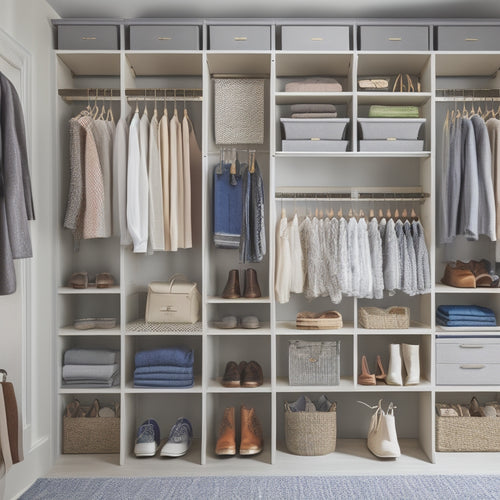
Maximize Your Space: 10 DIY Closet Hacks
You can open up to 30% more storage space in your closet by implementing a few simple DIY hacks. Start by maximizing ...
-
What Makes Ideal Kitchen Storage Solutions
In your ideal kitchen, you'll find a harmonious balance of style and functionality, where every item has a designated...
-

3 Kitchen Hacks for a Clutter-Free Home
You can achieve a clutter-free kitchen by implementing three simple hacks: clear off countertops by designating spots...
